Energy and Resource Management
BES continuously collects and reviews energy consumption data, implementing improvement measures for high-energy-consuming equipment. This includes replacing inefficient lighting fixtures, phasing out unnecessary equipment, and incorporating energy-efficient equipment standards into our standardized processes, which helps establish effective operational controls to enhance energy efficiency.
Assessment Mechanism
We have established relevant regulations for water and electricity usage, outlining the behavior of employees and conducting inventories of energyinefficient and outdated equipment in both the Head Office and on construction sites. Each department manager is responsible for supervising employee actions and implementing equipment replacement. Additionally, we use models such as PDCA to record monthly data on water and electricity usage to continuously review areas for improvement.
Greenhouse Gas Emissions Statistics
Greenhouse Gas Emissions Volume and Emissions Intensity over the Past Three Years
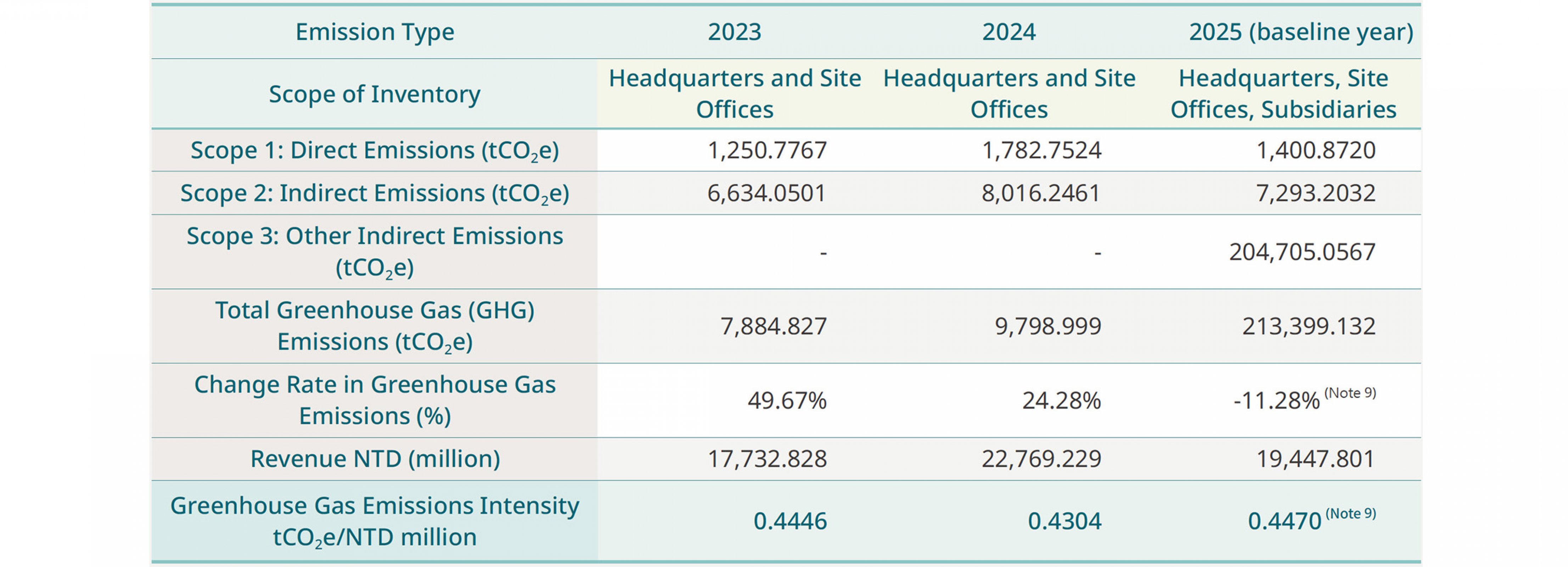
Note 9: Scope 3 was included for the first time in 2025. To maintain annual comparability, the change rate in GHG emissions and emissions intensity in this table were calculated based on Scope 1 and Scope 2 emissions.
BES’Improvement Measures
1.The Head Office of BES has replaced lighting fixtures with energy-efficient ones and removed unnecessary lighting and other energy-consuming equipment.
2.All newly established engineering offices use energy-saving LED lighting fixtures.
3.We have strengthened online collaboration and paperless operations, consolidated photocopying equipment, and reduced printing and photocopying needs.
4.BES promoted electronic documents and paperless construction budgets to reduce paper consumption.
5.Installation of timed switches for air conditioning units, replacing old air conditioners with energy-efficient models, adjusting the thermostat temperature.
(26° C + fan) and not using air conditioning during the winter months from November to February.
BES Energy Usage Status
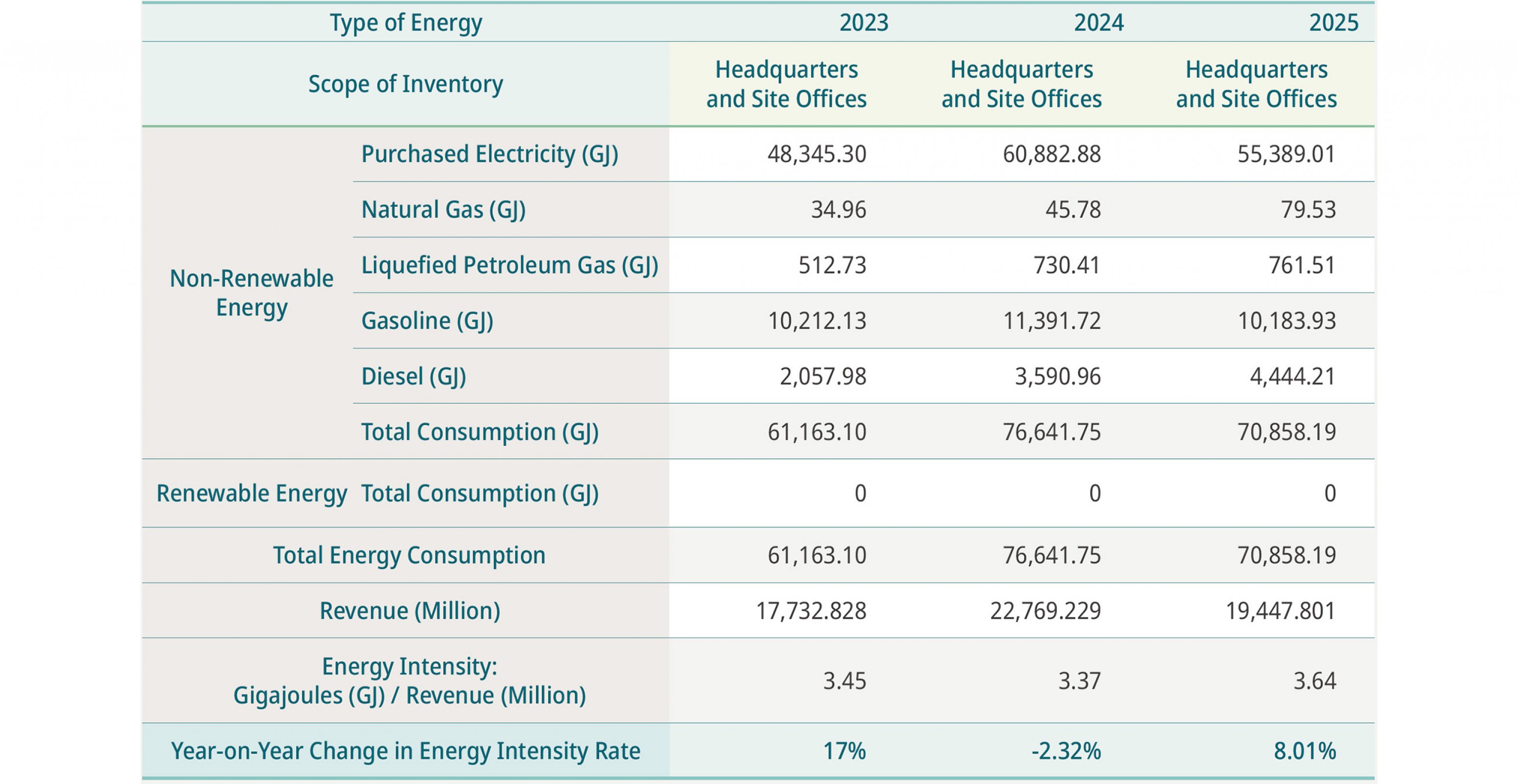
BES’s energy consumption consists primarily of indirect energy emissions (78.17% of total energy consumption) and direct emissions (21.83% of total energy consumption), with externally purchased renewable energy (electricity) accounting for 0% of total energy consumption. In 2025, total energy consumption was 70,858.19 GJ, a decrease of 7.55% year-on-year; the main reason was that some construction sites were entering a low-activity phase and some sites had already been completed. Energy intensity increased by 8.01% compared to 2024. In 2025, BES’s energy usage increased while revenue declined in some areas, with the most significant increase in diesel usage. To improve energy efficiency, BES will continue to require each site office to take energy-saving measures and strictly control energy usage.
Internal Energy Usage Over the Past Three Years
Water Consumption
All water consumption at BES' headquarters is domestic water. According to the invoices from the water company, all water sources for the engineering offices are the temporary water supplies applied from the water company, making it third-party water. All water consumed by BES is domestic water consumed for engineering offices, offices, construction and cleaning. In 2024, BES expanded the boundary for waster consumption calculation and yet the overall water withdrawl was still on the low side, testament to the company' s water management.
Water Resources Management and Water-Saving Initiatives
BES, during different stages of operations, adopts different water conservation measures, including assessing how to minimize runoff water pollution before commencing construction and recycling and reusing wastewater generated during the construction process.
Overall, the company explores water-saving methods through concepts such as water management, water reduction, rainwater storage and utilization and water recycling. The company has created waters efficient water resource management methods by combining water withdrawal and water conservation with our experience from various projects as well as our actual actions. These methods include:
▪Wastewater recycling:A reservoir is set up next to the construction site' s car wash area to store and recycle the dirty water used for vehicle washing. After sedimentation and purification, the water can be reused.
▪ Rainwater recovery:The water required for the concrete curing process is the rainwater collected from using water- stopping piers/thresholds or reduced using curing agents. The collected rainwater, after passing through sedimentation, can also be reused for road cleaning to suppress dust.
▪ Installation of Equipment with Water Efficiency Label:BES follows the policies of the Water Resources Agency under the Ministry of Economic Affairs to encourage consumers to choose water-efficient products. Water-saving equipment with water efficiency labels is installed in both the Company' s Head Office and engineering offices.
▪ Installation of Wastewater Treatment Facilities:Wastewater treatment facilities are installed at discharge points to ensure that the discharged wastewater meets the discharge standards.
Energy and Resource Management
BES continuously collects and reviews energy consumption data, implementing improvement measures for high-energy-consuming equipment. This includes replacing inefficient lighting fixtures, phasing out unnecessary equipment, and incorporating energy-efficient equipment standards into our standardized processes, which helps establish effective operational controls to enhance energy efficiency.
Assessment Mechanism
We have established relevant regulations for water and electricity usage, outlining the behavior of employees and conducting inventories of energyinefficient and outdated equipment in both the Head Office and on construction sites. Each department manager is responsible for supervising employee actions and implementing equipment replacement. Additionally, we use models such as PDCA to record monthly data on water and electricity usage to continuously review areas for improvement.
Greenhouse Gas Emissions Statistics
Greenhouse Gas Emissions Volume and Emissions Intensity over the Past Three Years
Note 9: Scope 3 was included for the first time in 2025. To maintain annual comparability, the change rate in GHG emissions and emissions intensity in this table were calculated based on Scope 1 and Scope 2 emissions.
BES’Improvement Measures
1.The Head Office of BES has replaced lighting fixtures with energy-efficient ones and removed unnecessary lighting and other energy-consuming equipment.
2.All newly established engineering offices use energy-saving LED lighting fixtures.
3.We have strengthened online collaboration and paperless operations, consolidated photocopying equipment, and reduced printing and photocopying needs.
4.BES promoted electronic documents and paperless construction budgets to reduce paper consumption.
5.Installation of timed switches for air conditioning units, replacing old air conditioners with energy-efficient models, adjusting the thermostat temperature.
(26° C + fan) and not using air conditioning during the winter months from November to February.
BES Energy Usage Status
BES’s energy consumption consists primarily of indirect energy emissions (78.17% of total energy consumption) and direct emissions (21.83% of total energy consumption), with externally purchased renewable energy (electricity) accounting for 0% of total energy consumption. In 2025, total energy consumption was 70,858.19 GJ, a decrease of 7.55% year-on-year; the main reason was that some construction sites were entering a low-activity phase and some sites had already been completed. Energy intensity increased by 8.01% compared to 2024. In 2025, BES’s energy usage increased while revenue declined in some areas, with the most significant increase in diesel usage. To improve energy efficiency, BES will continue to require each site office to take energy-saving measures and strictly control energy usage.
Internal Energy Usage Over the Past Three Years
Water Consumption
All water consumption at BES' headquarters is domestic water. According to the invoices from the water company, all water sources for the engineering offices are the temporary water supplies applied from the water company, making it third-party water. All water consumed by BES is domestic water consumed for engineering offices, offices, construction and cleaning. In 2024, BES expanded the boundary for waster consumption calculation and yet the overall water withdrawl was still on the low side, testament to the company' s water management.
Water Resources Management and Water-Saving Initiatives
BES, during different stages of operations, adopts different water conservation measures, including assessing how to minimize runoff water pollution before commencing construction and recycling and reusing wastewater generated during the construction process.
Overall, the company explores water-saving methods through concepts such as water management, water reduction, rainwater storage and utilization and water recycling. The company has created waters efficient water resource management methods by combining water withdrawal and water conservation with our experience from various projects as well as our actual actions. These methods include:
▪Wastewater recycling:A reservoir is set up next to the construction site' s car wash area to store and recycle the dirty water used for vehicle washing. After sedimentation and purification, the water can be reused.
▪ Rainwater recovery:The water required for the concrete curing process is the rainwater collected from using water- stopping piers/thresholds or reduced using curing agents. The collected rainwater, after passing through sedimentation, can also be reused for road cleaning to suppress dust.
▪ Installation of Equipment with Water Efficiency Label:BES follows the policies of the Water Resources Agency under the Ministry of Economic Affairs to encourage consumers to choose water-efficient products. Water-saving equipment with water efficiency labels is installed in both the Company' s Head Office and engineering offices.
▪ Installation of Wastewater Treatment Facilities:Wastewater treatment facilities are installed at discharge points to ensure that the discharged wastewater meets the discharge standards.